
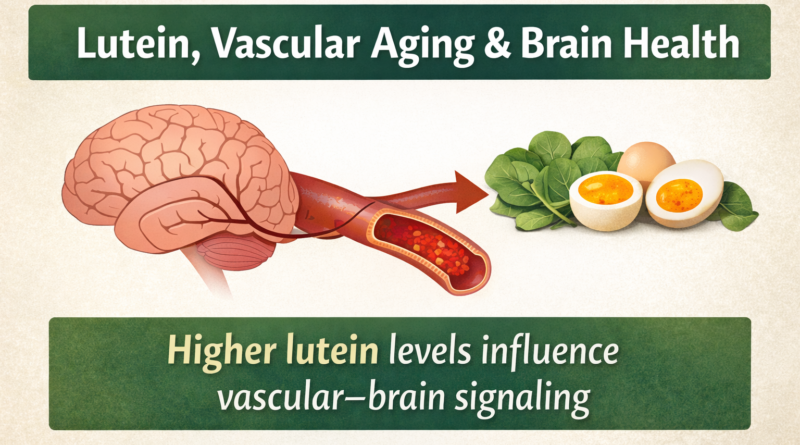
Lutein in Your Diet May Influence How Vascular Aging Impacts the Brain, New Study Shows
Lutein in Your Diet May Influence How Vascular Aging Impacts the Brain, New Study Shows
Disclaimer: Some content on this site is created with the assistance of artificial intelligence (AI) and is reviewed and edited by a human for accuracy, clarity, and relevance. AI is used as a tool to support content creation, not as a substitute for professional judgment. This site may also include Amazon Associate links. As an Amazon Associate, we may earn a small commission from qualifying purchases at no additional cost to you. All content is for informational and educational purposes only and is not intended as medical advice.
A November 2025 study published in The Journal of Nutrition suggests that the common dietary carotenoid lutein—found in leafy greens, egg yolks and other colorful foods—may play a unique role in how vascular health affects cognitive performance. The research provides fresh insight into the complex links between arterial stiffness and executive function, highlighting diet as a potential factor in preserving brain health across adulthood.
Researchers from the University of Illinois and collaborating institutions conducted a cross-sectional analysis of 60 adults, combining measures of vascular aging with detailed cognitive testing. Arterial stiffness was assessed using carotid-femoral pulse wave velocity (cfPWV), a standard measure of vascular aging and cardiovascular risk. Participants also underwent cognitive tasks designed to measure executive function—the set of mental skills involved in problem-solving, attention and inhibition control—while their brain activity was monitored via event-related potentials (ERPs).
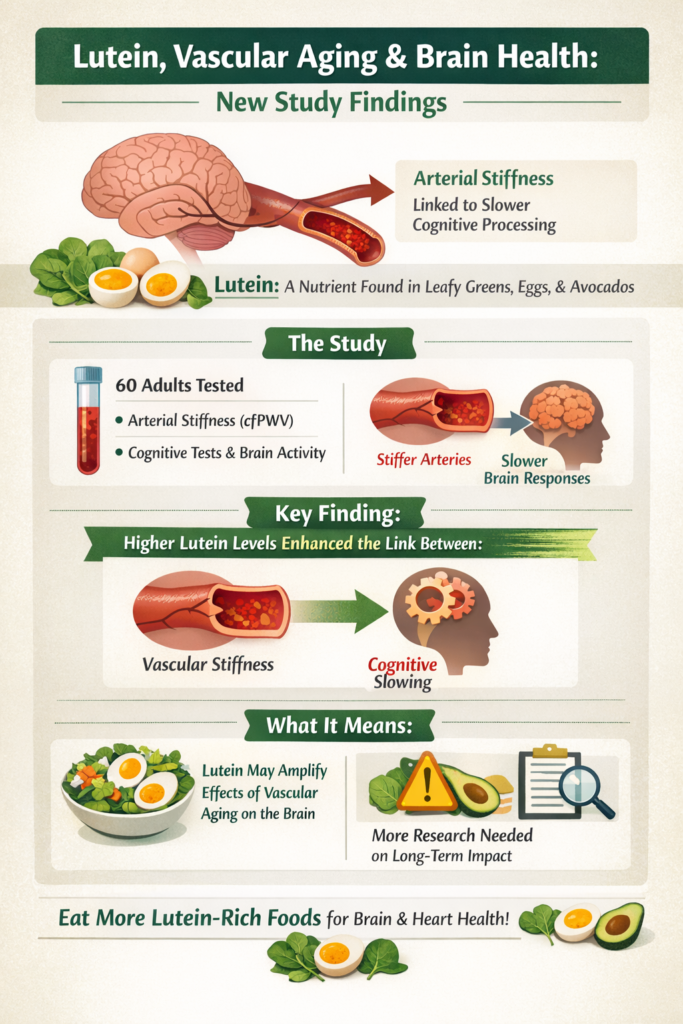
The study found that higher arterial stiffness was consistently associated with slower cognitive processing: individuals with stiffer arteries showed slower reaction times and delayed neural responses during executive function tests.
However, when researchers examined participants’ blood levels of carotenoids—naturally occurring plant pigments with known antioxidant properties—one nutrient stood out. Despite lycopene being the strongest overall predictor of arterial stiffness, serum lutein levels uniquely influenced how arterial stiffness related to cognitive performance. In statistical models, higher lutein concentrations amplified the observed association between vascular stiffness and delayed cognitive responses on specific executive function measures.
This “moderation effect” suggests that lutein may interact with vascular and neural processes in the aging brain in ways that extend beyond simply influencing arterial health. While lycopene predicted the degree of stiffness itself, lutein appeared to shape how that stiffness was reflected in cognitive processing speed.
It is important to note that cross-sectional designs cannot prove cause-and-effect relationships. Nonetheless, the data add to a growing body of research exploring how nutrition intersects with vascular and neurocognitive health.
Verma et al. Vascular Roads to a Healthier Brain: Lutein Moderates the Influence of Arterial Stiffness on Cognitive Function. The Journal of Nutrition. 2025. [Read the study]
In statistical models, higher lutein concentrations amplified the observed association between vascular stiffness and delayed cognitive responses on specific executive function measures.
For now, however, the study lends support to public health messages encouraging diets rich in fruits, vegetables, and other whole foods—not only for heart health but potentially for preserving cognitive function as well.
Read More: Verma S, Kinder CJ, Kim J, Pascual-Abreu M, Black M, Erdman JW Jr, Khan NA. Vascular Roads to a Healthier Brain: Lutein Moderates the Influence of Arterial Stiffness on Cognitive Function. J Nutr. 2025 Nov;155(11):3974-3986. doi: 10.1016/j.tjnut.2025.08.029.